
Agentic Product Configurator
Simplify Configuration, Launch Faster, Scale Without Limits
Turn static insurance product documentation into governed, deployment-ready configurations. Leverage insurance-native AI to automate validation, eliminate manual coding, and accelerate product innovation at enterprise scale.
Why Carriers Leverage Agentic Product Configurator
Traditional product configuration takes months of slow, manual, and fragmented requirements analysis and XML authoring. Duck Creek eliminates these bottlenecks using orchestrated AI agents.
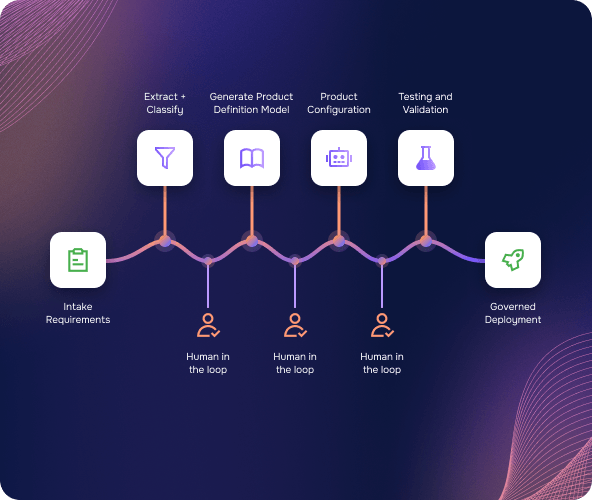
Accelerate Product Launches


- Compress end-to-end product configuration timelines from months to weeks.
- Automate complex requirements generation and product blueprint creation.
- Streamline the path from initial documentation to live deployment.
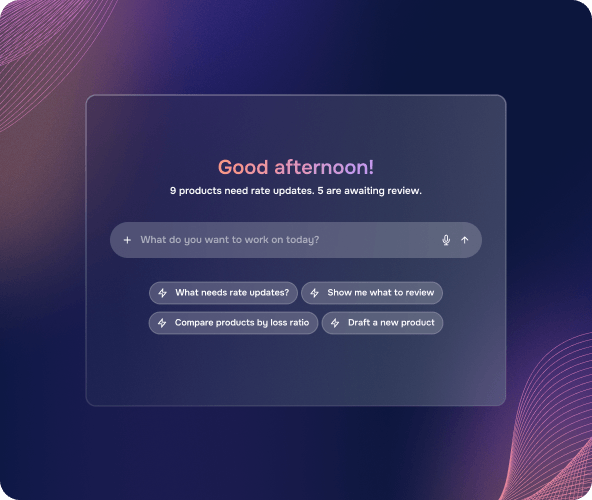
Reduce Implementation Costs
- Dramatically lower manual effort for SMEs, analysts, and development teams.
- Maximize ROI by reusing proven manuscript fragments and rating logic.
- Slash costs associated with updates, migrations, and third-party implementation resources.
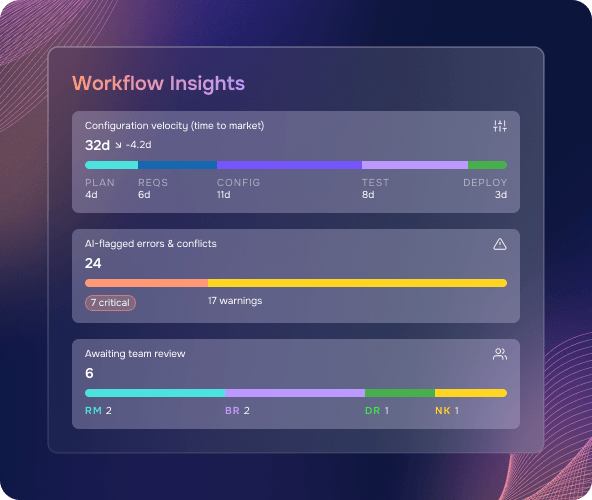
Improve Quality and Control
- Reduce defects and rework through automated schema and regression validation.
- Ensure configuration integrity with human-in-the-loop oversight and structured approvals.
- Eliminate unsupported changes with deterministic, audit-ready compilation.
Quantifiable Value at Scale
Expected faster time to market
Platform for the full lifecycle
Scale innovation with confidence
Consistent quality, every launch


Frequently Asked Questions
Agentic Product Configurator is insurance-native and Duck Creek-specific. It does not simply summarize documents or generate generic text; it ingests carrier documentation, creates a governed Product Definition Model, compiles manuscript/XML through deterministic services, validates outputs, and preserves human approval at key decision points.
Initial capabilities are available in Controlled Availability through Professional Services as an SOW-based engagement, starting with requirements understanding and manuscript generation for new Duck Creek Policy implementations. Broader productized access, packaging, partner access, and expanded workflows are part of the roadmap.
It shifts teams from manually building configuration from scratch to reviewing and refining an AI-generated baseline. The platform ingests requirements and source artifacts, creates a product blueprint, reuses proven configuration patterns, compiles manuscript/XML, and produces validation outputs and deployment-ready packages.
Every product change remains subject to deterministic validation and human approval. The product definition, generated configuration, validation results, and approval evidence are connected through traceability, audit logs, lineage, and structured release gates.
No. The intended positioning is augmentation, not replacement. It helps internal teams, Professional Services, and future partner users spend less time on manual interpretation, XML authoring, and repetitive validation, and more time on strategy, exception handling, governance, and quality review.
Yes. The vision is additive to Duck Creek configuration workflows and the broader Duck Creek Suite. It starts with Policy-focused requirements and manuscript generation, while the roadmap expands the prompt-to-configuration experience across additional Duck Creek products, workflows, and lifecycle use cases.
Resources to Power Your Knowledge
Trusted resources selected for distribution and compliance leaders